Book Your Summer Clinic Now! Enroll Now
Book Your Summer Clinic Now! Enroll Now
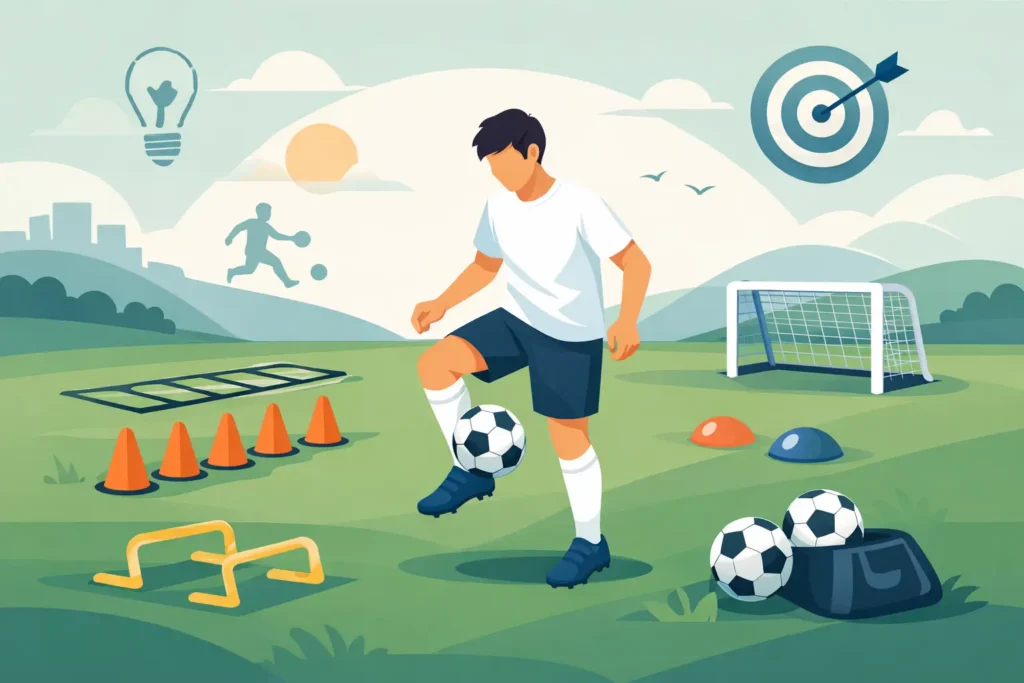
A player who touches the ball 500 times alone will usually improve faster than a player who waits all week for team practice. That is why the best individual soccer drills are not flashy. They are simple, repeatable, and tied to the actions players actually need in games.
For young players, solo training builds comfort on the ball. For competitive players, it sharpens speed of play, first touch, and decision-making under pressure. For parents, it creates a clear way to turn extra time into real development instead of random backyard workouts. The key is choosing drills that build habits, not just break a sweat.
The strongest drills do three things well. First, they give a player a high number of quality repetitions. Second, they force focus on clean technique instead of rushing through touches. Third, they can be adjusted based on age, level, and position.
That last part matters. A 9-year-old learning to use both feet does not need the same session as a high school winger working on explosive change of direction and finishing off the dribble. Good individual training is never one-size-fits-all. The drill may stay the same, but the speed, pressure, and standard should change.
If a player can control the ball in a small area, everything else gets easier. Set up a five-by-five yard box and work through foundations, inside-inside touches, outside-inside touches, sole rolls, pull-push moves, and scissors. Keep the ball close and the body balanced.
This drill looks basic, and that is exactly why it works. Players get hundreds of touches while improving coordination, rhythm, and weak-foot confidence. Younger athletes should focus on control and posture. Older players should increase tempo without losing sharpness.
A wall is one of the best training partners a player can have. Pass with the inside of the foot, receive across the body, and play the next pass with purpose. Alternate feet and vary the angle of the first touch.
This is one of the best individual soccer drills because it trains technique and game realism at the same time. A bad first touch shows up immediately. So does poor body shape. More advanced players can add one-touch passing, open up to both sides, or check away before receiving.
Set up five to eight cones in a straight line or staggered pattern. Dribble through under control, then accelerate out of the final cone. The detail that many players miss is the burst at the end. In matches, the move is not what creates separation. The acceleration after the move does.
This drill improves close control, body feints, and balance. It also teaches players not to admire their footwork. Quick feet matter, but quick exits matter more.
Toss the ball up or use a wall to create bounce and height. Bring it down with the laces, thigh, or inside of the foot, then push into space with the next touch. Players who struggle here often trap the ball dead instead of directing it.
That is the difference between surviving a touch and using it. A strong first touch should prepare the next action. Midfielders and forwards especially benefit from this because they often receive difficult balls under pressure.
Create small passing gates with cones a few yards apart. Dribble toward one, pass through it, move to receive the ball again, then attack the next gate. This blends dribbling, passing accuracy, and movement.
It is a useful bridge drill for players who are comfortable with stationary passing but not yet clean while moving. The trade-off is that it requires more setup and focus than simple wall work. Still, for players who need more game-like rhythm, it is worth it.
Juggling is helpful, but only when it has structure. Instead of counting random touches, set rules. Use only the left foot for 20 touches. Alternate foot-thigh-foot. Add a spin and recover. Cushion the ball on contact rather than popping it wildly.
Juggling improves touch, concentration, and body control. It does not replace passing or dribbling work, but it supports them. Players who avoid juggling because they are not good at it are usually avoiding a weakness they need to address.
Pick one move and repeat it with intent. That could be a scissors, body feint, inside cut, outside cut, or Ronaldo chop. Approach a cone or marker as if it were a defender, execute the move at speed, then explode away.
This is where discipline matters. Many players collect ten different moves and master none of them. It is better to own two or three reliable moves and be able to use them under pressure. Repetition creates confidence. Confidence creates timing.
Not every player has a training partner to set up shots, so self-service finishing matters. Toss the ball in front, let it bounce once, and strike. Dribble into a shot from different angles. Pull the ball across the body and finish with the far foot. If space allows, work on driven finishes, placement, and quick-release shooting.
Players should not just blast balls without a target. Pick corners, vary surfaces, and pay attention to balance through contact. A player who can create a shot alone becomes much more dangerous in games.
Set up a starting cone, a receiving cone, and a gate to pass or dribble through after the turn. Start behind the receiving cone, check away, come back to the ball, take the first touch across the body, and turn into space.
This is an excellent drill for midfielders and defenders who need to receive under pressure and get out cleanly. The small detail is scanning before the ball arrives. Even in solo training, players should build the habit of checking shoulders and opening their body before the first touch.
Soccer speed is not just running fast in a straight line. It is the ability to push the ball at the right distance and keep form while accelerating. Set cones 10 to 20 yards apart and dribble at near top speed without losing control.
This drill exposes a lot. Some players take touches that are too small and never open up. Others knock the ball too far and start chasing it. The goal is controlled speed, not chaos.
Use cones, a ladder if available, or simple line markings. Shuffle, open hips, backpedal, then react into a short dribble or pass. The best version includes a ball at the end, because soccer movement should lead into soccer actions.
Foot speed alone is overrated if it does not transfer. A player can look quick in a ladder and still be slow to the ball. That is why the final action matters.
This may be the most valuable drill category for long-term growth. Build a short circuit using only the weak foot for passing, receiving, dribbling, and finishing. Keep the tempo manageable and the standard high.
Most young players avoid this because it feels uncomfortable. That discomfort is part of development. The weak foot does not improve through occasional use. It improves through focused repetition over time.
A good individual session does not need to be long. For most players, 30 to 45 minutes of focused work is better than 90 minutes of sloppy repetition. Start with ball mastery to get sharp. Move into one passing or first-touch activity. Then add a dribbling or 1v1 component, and finish with shooting, speed work, or weak-foot reps.
If the player is younger, keep the session moving and avoid over-coaching every touch. If the player is older and more competitive, raise the standard and track results. Count clean passes in a row. Time dribbling sets. Measure how many quality finishes hit the target. Progress should be visible.
At 50/50 Futbol, that structure matters because players improve faster when training is organized around a clear objective instead of random effort. More work is not always better. Better work is better.
The biggest mistake is going too fast before technique is clean. Players rush through touches, finish sloppily, and call it a hard session. Hard is not the same as effective.
Another issue is repeating only favorite drills. Most players naturally train strengths and avoid weaknesses. That feels good in the moment, but it slows real development. Honest players spend time on the foot, move, or receiving pattern they trust the least.
Finally, many players train without intensity changes. Game actions are rarely done at one speed. There is control, then burst. There is patience, then acceleration. The best individual soccer drills teach that contrast.
For younger players, ball mastery, juggling, cone dribbling, and wall passing should make up most of the work. Those build the foundation. At that age, consistency matters more than complexity.
For middle school and high school players, first touch, turning, finishing, and speed with the ball become more important. As the game gets faster, players need cleaner technique under more pressure. Advanced players should also train by position. Wide players need isolation moves and crossing patterns. Midfielders need scanning, receiving, and directional play. Defenders need clean first touch, passing range, and recovery footwork.
The best drill is not always the hardest one. It is the one that matches the player’s current level, addresses a real need, and gets repeated often enough to stick.
The players who improve the most are usually not the ones chasing complicated sessions. They are the ones who show up, stay disciplined, and do simple work with high standards. If a player can build that habit, progress stops being a guess and starts becoming expected.