Book Your Summer Clinic Now! Enroll Now
Book Your Summer Clinic Now! Enroll Now
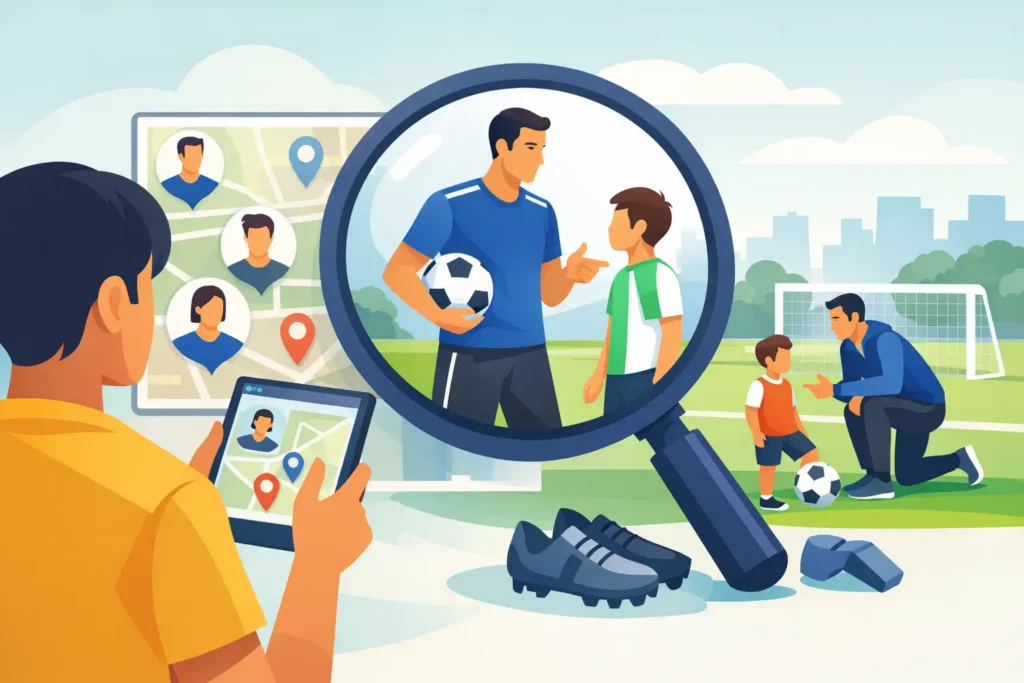
If you have typed best private soccer coach near me into a search bar, you are probably not looking for more noise. You are looking for a coach who can actually help a player improve – not just sweat for an hour, not just run drills, and not just hear the same team-practice instructions one more time.
That search usually starts when a parent sees potential that is not being developed fast enough, or when a player knows there is another level to reach. Maybe the first touch is inconsistent. Maybe decision-making under pressure is too slow. Maybe confidence drops during matches even though training effort is high. Private coaching can help, but only when the coach brings structure, accountability, and a plan that fits the player in front of them.
A good private coach does more than set up cones and keep the session moving. The best one teaches with purpose. Every exercise should connect to something specific: receiving under pressure, striking cleanly, changing direction efficiently, scanning sooner, defending 1v1s, or improving position-specific habits.
That matters because private training is not team training. In a team setting, a coach has to manage a group, install tactics, and divide attention across many players. In a private session, the standard should be higher. The player should get repeated reps, immediate correction, and feedback that is specific enough to change performance.
For younger players, that may mean simplifying the game and building clean technical habits early. For competitive middle school and high school players, it often means speeding up execution, improving discipline on the ball, and learning how to apply technique at game pace. For advanced athletes, the work usually gets even more detailed – body shape, timing, awareness, movement before the ball arrives, and sharper decisions in position-specific moments.
Not every trainer with a ball bag is the right coach for your child. Credentials alone do not guarantee results, but they do matter. A coach with real playing and coaching experience often sees details that less experienced trainers miss.
Look for evidence that the coach understands different levels of the game. Can they work with a beginner without overcomplicating things? Can they also challenge a serious player who wants to compete at the academy, high school, college, or professional level? That range matters because development is not one-size-fits-all.
A credible coach should also be able to explain how they teach. If the method is vague, the results usually are too. Strong coaches tend to use simple language, clear demonstrations, and repetition with correction. They know that confidence is built when players understand what they are doing, why they are doing it, and how to repeat it correctly.
This is where many families waste time and money. A session can look active and still be ineffective. Plenty of movement does not always equal improvement.
A strong private coach watches carefully and adjusts in real time. If a player keeps opening up too early when receiving, the coach addresses body position. If a striker is making the right run but finishing poorly, the coach breaks down contact, timing, and balance. If a defender is athletic but dives in too often, the coach teaches patience, angles, and footwork.
The best private soccer coach near me search should lead you to someone who diagnoses problems and fixes them with repetition. Not random repetition, but focused repetition. There is a difference.
A coach does not need a long sales pitch to be effective. In fact, the best conversations are often the clearest ones. Parents should leave that first interaction understanding what the coach emphasizes, how sessions are structured, and what kind of player benefits most from the training.
Ask what a typical session looks like. Ask how progress is measured. Ask whether the coach works on technical ability only, or also includes tactical awareness, agility, speed, fitness, and position-specific development. If your child is shy, ask how the coach builds confidence. If your player is advanced, ask how training is adapted to match pace and competitive demands.
You should also ask about consistency. Real development rarely comes from one or two sessions. It usually comes from repeated work over time, with clear habits being built week after week. A coach who understands long-term development will be honest about that.
The right fit is not only about credentials. It is also about communication, standards, and trust.
A strong coach is clear without being confusing. Demanding without being negative. Supportive without lowering standards. Players should leave sessions knowing what they did well, what needs work, and what the next step is.
There should also be a noticeable balance between challenge and encouragement. Some players need more confidence. Others need more accountability. The best coaches know how to apply both. They do not coach every player the same way because not every player learns the same way.
For families in the Palm Beaches, this is especially important because there are many training options. Some focus mostly on volume. Some are better for casual players. Others are designed for serious athletes who want a more professional environment. That is why fit matters as much as convenience.
Parents often assume private training is always the best option. Sometimes it is. Sometimes it is not.
One-on-one training is ideal when a player needs highly specific correction, more confidence on the ball, or targeted work tied to a position or performance gap. It is also useful when a player is coming back from time away and needs a structured rebuild.
Semi-private or small-group sessions can be excellent when the player benefits from competition, reaction-based work, and learning to execute skills around others. The trade-off is that individual attention is slightly reduced, but the environment can feel more game-like.
The right answer depends on the player’s age, level, personality, and goals. A good coach will not force the same format on everyone. They will recommend what actually helps the player improve.
When families search for the best private soccer coach near me, location is not just about driving distance. It is about familiarity with the local soccer environment.
A coach who works regularly with players in your area understands the competitive landscape. They know what local club players struggle with, what high school athletes need, and how to prepare players for the speed and physical demands they will face in South Florida. That context helps training stay realistic.
If the coach also has experience working across age groups and levels, that is even better. It means they can meet a young beginner where they are while still preparing advanced players for the next stage of the game.
This is one reason many families in the Palm Beaches look for specialized training rather than general fitness sessions with a soccer ball mixed in. Soccer development is technical. It is tactical. It is physical. Most of all, it is specific.
Improvement is not always dramatic in the first week. That is worth saying clearly. Good coaching often shows up first in details before it shows up in highlight moments.
A player may start scanning earlier, receiving cleaner, striking with better balance, or staying calmer under pressure. Then the game starts to look easier. Confidence grows because actions become more repeatable. That is usually the foundation for bigger results later – more impact in matches, better decisions, and stronger consistency.
At 50/50 Futbol, that development mindset is central. The goal is not to impress players for an hour. The goal is to build habits that carry into real games through structured training, honest feedback, and repetition that has a purpose.
The best choice is rarely the one with the flashiest social media clips or the loudest claims. It is the coach who can teach clearly, correct precisely, and create a training environment where your player is challenged to improve every time they step on the field.
If you are comparing options, pay attention to how specific the coach is, how well they communicate, and whether their training philosophy matches your player’s needs. Progress comes from more than effort alone. It comes from the right guidance, delivered consistently, by someone who understands both the game and the player.
A good private coach can make a player work harder. A great one can make the work count.