Book Your Summer Clinic Now! Enroll Now
Book Your Summer Clinic Now! Enroll Now
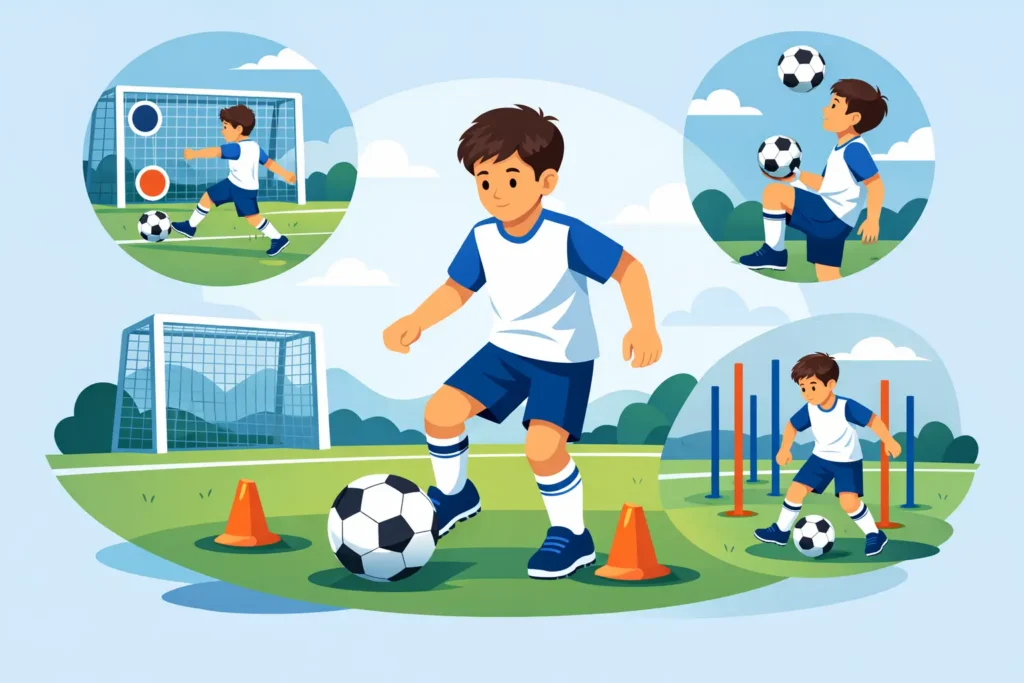
A 10-year-old does not need a complicated training plan. They need the ball at their feet, clear coaching points, and enough repetition to turn awkward touches into confident ones. The best individual soccer drills for 10 year olds are simple, structured, and challenging without becoming frustrating.
At this age, players are building habits that stick. That is why solo work matters so much. Team practice helps with spacing, passing, and game understanding, but individual training is where a player really improves first touch, coordination, ball control, and comfort in tight spaces. When done the right way, 15 to 30 minutes of focused work can produce real progress.
The right drills for this age should do three things. First, they should give a high number of quality repetitions. Second, they should be easy to understand. Third, they should develop technique before speed. A lot of young players want to rush, but if the touches are sloppy, moving faster only reinforces bad habits.
Parents should also know that more is not always better. A child does not need 20 different activities in one session. Four or five well-chosen drills, done with attention and consistency, usually work better than a long workout filled with random exercises.
If a player is 10 years old, ball mastery should be a major priority. Before advanced tactics or position-specific training, they need control of the ball with both feet.
Start with toe taps on top of the ball, then move into foundations, which means quick inside touches back and forth between the feet. These are basic drills, but they matter because they improve rhythm, balance, and coordination. Keep the player light on their toes, knees bent, and eyes up every few touches.
A good standard is 20 to 30 seconds of work, followed by a short rest, repeated for several rounds. The goal is not just speed. The goal is clean, controlled touches.
Have the player use the inside and outside of the same foot while moving forward for a few yards, then switch feet coming back. This teaches control on different surfaces of the foot and helps young players become less one-sided.
At 10 years old, many players strongly prefer one foot. That is normal, but it should not be ignored. Drills like this help close the gap early.
Not every cone drill improves game performance. Some look impressive but train patterns players rarely use. For this age group, the best dribbling work teaches close control, change of direction, and body balance.
Set up five to seven cones in a straight line, spaced a few feet apart. The player dribbles through with small touches, using both feet. On the way back, they can use only the weaker foot.
This sounds simple, but it is one of the most effective solo drills because it teaches the player to keep the ball close instead of kicking it and chasing it. If the touches are too big, slow the drill down. Clean movement matters more than racing through the cones.
Create a small square and have the player dribble inside it while changing direction on command or after every few touches. They can use pullbacks, inside cuts, outside cuts, and sole rolls.
This drill is valuable because games are not played in straight lines. Players need to stop, turn, protect the ball, and accelerate again. A small space forces quick decisions and sharper control.
A lot of parents assume passing drills require another player. They do not. A wall is one of the best training tools a young player can use.
Have the player pass against a wall and control the ball before passing again. Focus on receiving across the body, not stopping the ball dead every time. That first touch should prepare the next action.
This is where many 10-year-olds improve quickly. The wall gives instant feedback. A poor pass comes back poorly. A clean pass comes back predictably. That kind of repetition builds consistency.
Once two-touch passing looks solid, add one-touch passing in short bursts. Keep it realistic. At this age, one-touch work should be brief and controlled, not forced for long periods.
If technique starts to break down, go back to two touches. That is not a setback. It is good coaching. Players improve faster when the drill matches their current level.
If the player has access to a goal or even a small target, finishing work should be part of the routine. But solo shooting for 10-year-olds should focus on technique, not power.
Set up a cone, dribble at it, make a move, then finish into the corner of the goal. Alternate sides and feet. Keep the coaching points simple – head steady, plant foot beside the ball, and strike through the center or slightly across it depending on the finish.
Young players often want to blast every shot. That usually leads to poor balance and wild accuracy. At this age, composed finishing is more useful than hard finishing.
If using a wall or rebounder, the player can pass into it and finish the returning ball first time. This adds timing and body shape to the shot.
The trade-off is difficulty. Some 10-year-olds are ready for this. Others are not. If the player cannot consistently connect cleanly, simplify the drill and rebuild from there.
Parents often hear that speed and agility training are important, and they are. But for 10-year-olds, that work should support soccer technique, not replace it.
Set up a ladder or just use flat markers. Have the player perform a quick footwork pattern, then immediately collect a ball and dribble through cones. This connects coordination to soccer movement.
That connection matters. Straight athletic drills have value, but soccer players need to apply foot speed while controlling the ball. Even a basic pattern followed by five seconds of dribbling can make the session more game-relevant.
Set a start and finish line 10 to 15 yards apart. The player explodes forward with the ball, keeps it under control, then slows down properly at the end. This helps teach acceleration without losing technique.
For younger players, longer sprint dribbling can get messy. Short distances are usually better because they encourage sharper touches and better posture.
The best training sessions for this age are short, focused, and repeatable. A strong solo session might include ball mastery, a dribbling pattern, wall passing, and finishing. That is enough.
A good weekly routine could be three individual sessions of 20 to 30 minutes. That gives enough repetition to create progress without burning the player out. Consistency wins here. One great session followed by ten days off does not help much.
This is also where coaching matters. If a child repeats the same mistake for weeks, the reps alone will not fix it. The best development comes from repetition plus correction. That is one reason structured training environments, like the ones 50/50 Futbol emphasizes, help players improve faster. Simplicity works, but only when the details are coached correctly.
One mistake is choosing drills that are too advanced. A 10-year-old does not need flashy combinations they saw online if they still struggle with basic inside touches or receiving the ball cleanly.
Another mistake is focusing only on the dominant foot. Stronger players at older ages are usually the ones who started developing both feet early. The weaker foot may feel uncomfortable now, but that discomfort is part of growth.
The last big mistake is training without intensity or purpose. Casual touches are better than nothing, but real improvement happens when the player is engaged. Ask for clean technique, concentration, and effort in short bursts.
At this age, individual work is not about creating a finished player. It is about building a confident one. A 10-year-old who can control the ball, use both feet, turn in tight spaces, and strike the ball cleanly will enjoy the game more and compete better in team settings.
That is why the best individual soccer drills for 10 year olds are not the fanciest drills. They are the ones a child can repeat often, perform correctly, and gradually own. Keep the training simple, keep the standard high, and let steady repetition do its job.
The player who gets a little sharper each week usually becomes the one who looks completely different by the end of the season.