Book Your Summer Clinic Now! Enroll Now
Book Your Summer Clinic Now! Enroll Now
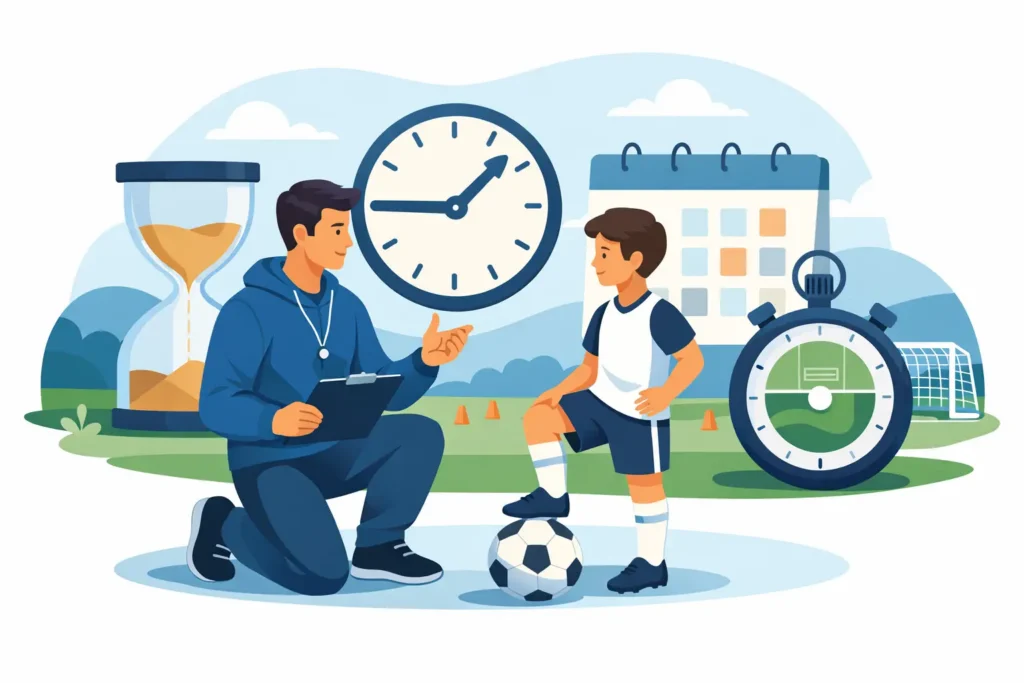
A 30-minute session can be perfect for one player and too short for another. That is usually what parents are really asking when they ask how long is private soccer training. They are not just asking about time on a calendar. They want to know how much training a player can handle, what leads to real improvement, and whether a longer session actually means better results.
The honest answer is that private soccer training usually lasts between 45 and 90 minutes. That range covers most players, from young beginners to advanced athletes. But the right session length depends on age, attention span, training history, goals, and how much intensity the coach expects from the player during that time.
For most youth players, 60 minutes is the standard. It gives enough time to get properly warmed up, work through technical repetitions, add movement and decision-making, and finish with a focused competitive element. An hour is long enough to create quality volume without letting concentration drop too much.
That said, not every player benefits from the same format. A younger child who is still learning body control, balance, and basic ball mastery may do better in 45 minutes. A high school athlete preparing for a season, trying to sharpen first touch, speed of play, or position-specific actions, may benefit from 75 or 90 minutes if the work is organized well.
The key point is simple. Session length should match the player, not the other way around.
A private session is different from team training. In a team environment, players spend time waiting, listening, rotating, and sharing repetitions. In private training, the player is involved almost the entire time. That changes the physical and mental demand.
An intense 60-minute private session can produce more technical reps and more direct coaching feedback than a much longer team practice. That is why longer is not always better. If the quality drops after 50 or 60 minutes, extra time may just mean tired touches, slower feet, and less concentration.
Good private training is built on repetition, accountability, and correction. The coach is watching details closely – body shape, timing, first touch, passing weight, finishing technique, movement off the ball, and decision-making under pressure. That level of focus is valuable, but it also takes energy from the player.
Younger players usually need shorter sessions. Players in the 6 to 9 range often do best in 30 to 45 minutes, especially if they are new to training. At that age, the goal is not to see how long they can last. The goal is to keep the session active, positive, and technically clean while building confidence.
Players from about 10 to 13 often respond well to 45 to 60 minutes. They can handle more repetition and more detail, but they still need a strong pace and clear structure. This is often the age where private training starts making a major difference because technical habits are still developing.
Players from 14 to 18 usually fit well into 60 to 90 minutes, depending on their level and goals. Competitive players in this group can often sustain higher intensity, absorb more tactical information, and handle position-specific work on top of technical training. Older athletes preparing for academy, high school, college, or elite competition may need sessions that push both quality and conditioning.
College and advanced players can also work in that 60 to 90 minute range, but the content matters even more than the clock. If the session includes high-speed technical actions, finishing, acceleration work, and repeated game-like scenarios, the total time does not need to be excessive.
If you are asking how long is private soccer training, the real answer depends on what the player needs most.
If the goal is technical development, 45 to 60 minutes is often ideal. Ball mastery, passing patterns, receiving, turning, dribbling, and finishing all require sharp execution. Once fatigue changes technique too much, the value drops.
If the goal includes fitness, agility, speed, or endurance, the session may run longer. But even then, smart coaches do not just add time for the sake of it. They adjust work-to-rest ratios, drill design, and training density so the player gets challenged without losing form.
If the player is returning from a break, recovering confidence, or just starting private sessions, shorter and more consistent training is usually better than one long session every so often. A focused 45-minute session each week can outperform an occasional 90-minute session if the player stays engaged and coachable.
Parents sometimes assume that a 90-minute session automatically gives more value than a 60-minute one. That is not always true.
A well-run 60-minute session should have a clear progression. The player arrives, gets activated, sharpens technique, applies it under movement or pressure, and finishes with work tied to game performance. Every block should have purpose. There should be corrections, repetition, and accountability throughout.
A poorly planned longer session can drift. The pace slows, the details get loose, and the player starts going through the motions. More minutes do not fix that.
This is especially important for younger athletes. Their improvement often comes from consistent exposure to correct technique and simple repeatable habits. They do not need endless volume. They need quality touches and direct feedback they can understand and apply.
Session length is only one part of development. Frequency matters just as much.
One 60-minute private session per week is a strong starting point for many players. It creates consistency without overwhelming a family schedule. For more serious athletes, two sessions per week can accelerate progress, especially when those sessions complement team training instead of duplicating it.
A player who trains privately for 60 minutes twice a week may improve faster than a player doing one 90-minute session, because the learning is reinforced more often. Repetition over time builds technique. Confidence comes from seeing those repetitions translate into games.
That is why coaches look at the full picture – session length, training frequency, match load, recovery, and the player’s long-term goals.
The right session length should leave a player challenged, coached, and better than when they started.
If a session is too short, it may feel rushed. There may not be enough time to warm up properly, repeat key actions, and connect the technical work to realistic soccer situations. The player finishes before the lesson really settles in.
If a session is too long, quality starts to fade. Touches get sloppy, movement slows down, and the player’s focus drifts. That does not mean hard work is bad. It means the coach has to know when productive fatigue turns into unproductive fatigue.
A good trainer watches for those changes. The best sessions are not measured only by how tired a player looks at the end. They are measured by how much meaningful work got done.
A private training session should feel structured from start to finish. Players should know what they are working on, why it matters, and where they need to improve. Parents should be able to see that the session is individualized, not random.
That is where experienced coaching makes a difference. The coach should be able to adjust session length and intensity based on the player’s age, level, and response on the day. Some players need a tighter, faster 45 minutes. Others are ready for a more demanding hour or longer. At 50/50 Futbol, that kind of adjustment is part of serious player development, not an extra feature.
Most of the time, the best answer is 60 minutes. It is long enough for serious technical work and short enough to maintain intensity and focus. But that is only the starting point. The best session length is the one that fits the player’s stage of development and keeps the quality high from the first touch to the last repetition.
If a player leaves training sharper, more confident, and clearer on what to improve next, the session was long enough. That is the standard that actually matters.